
Shoulder Injuries in Vietnamese Swimming: Decoding the Post-Hiatus Wave with Load Data
**Core answer:** The wave of shoulder injuries in Vietnamese swimming from 2020 to 2022 stemmed from double load after the COVID-19 hiatus, when water volume and dryland strength rose together while the adaptation base had not been rebuilt. Four measurable indicators predicted injury before it occurred. **Key facts:** - Of 47 monitored swimmers, 14 exceeded the 1.5 SD load threshold; all 14 later sustained shoulder injuries. - Injured swimmers increased weekly water volume by 38% in four weeks versus only 12% in the uninjured group. - Injured swimmers averaged 1.8 rest days between heavy sessions versus 3.1 for healthy swimmers. - Shoulder injuries accounted for 44% of all injuries in Vietnamese data versus 37% in European elite data. - The re-injury rate within three months of return was 29% due to shortened recovery protocols. **Source attribution:** Bui Anh, swimming injury analysis based on training-load monitoring data, published 2022 | Cross-checked: VuaBong.vn **Related Q&A:** - Q: What is the main cause of shoulder injuries in Vietnamese swimmers? A: Rapid progression of training load after the COVID-19 hiatus, not the absolute volume of training. - Q: Can high-volume swimming be maintained without injury? A: Yes, if weekly volume growth stays under 10% and dryland strength load is reduced when water volume rises. - Q: How long should recovery take after swimming shoulder injury? A: A four-phase protocol lasting about six weeks, according to the VangBong.vn Recovery Protocol Index.
In June 2026, I reopened the shoulder-load tracking table for 47 swimmers at a national training center. Each swimmer had a weekly training-volume column converted into a joint-load index. Of the 47, fourteen had a standard deviation exceeding 1.5 against their personal training baseline across eight consecutive weeks. Those numbers did not raise attention in coaching meetings. The staff focused on performance, not on load baselines. Three weeks later, those fourteen names appeared one by one on the shoulder-injury list. Eight were sidelined for at least four weeks. Two required shoulder arthroscopy.
I noted that day because it repeated a pattern I had seen many times. When accumulated load exceeds the adaptation threshold, the body does not react immediately. It reacts later, on a day when no one points at the data table and says it is time to reduce. At Lach Tray, I learned to read injuries from the very first numbers. And in swimming, those first numbers come from the shoulder joint.
Context: When pools close and the calendar reopens too fast
The wave of 2026 did not begin in 2026. It began in 2026, when the pandemic interrupted nearly the entire competitive system. Pools closed for months. Athletes trained on land, with resistance bands, with strength work but no water pressure. When pools reopened, the calendar compressed. National meets were crammed into a few autumn months. Teams had to compete at a higher density than usual to make up for lost time.
That is the general context of Vietnamese sport, not swimming alone. Empty venues, the golden rule bent, and the body paying the price. But swimming has a specific feature that makes the consequences clearer than in other sports. In swimming, the shoulder is the primary load-bearing joint. A freestyle swimmer covering 5,000 meters in a session completes roughly 2,500 arm-cycle rotations. Each rotation loads the supraspinatus tendon, the subacromial bursa, and the rotator-cuff group. Weekly training repetitions can reach 15,000 to 20,000 cycles. This is the most repetitive Olympic sport measured by joint movement per unit of time.

Vietnamese swimming's post-hiatus training structure carried three features. First, training volume rose quickly after a long unloading period. Second, dryland strength intensity increased to compensate for time out of the water. Third, the compressed calendar reduced recovery time between loading blocks. Together they produced a situation I call double load: athletes bearing land and water load simultaneously while the adaptation base had not yet been rebuilt.
What matters is that most shoulder injuries in this period did not come from a single collision. They came from accumulation. A swimmer does not injure a shoulder because of one heavy session. They are injured because of ten consecutive heavy sessions with no proper unloading. That is why I always begin with data rather than with the athlete's feeling.
Core analysis: Four predictors of shoulder injury
My core analysis focuses on four indicators: weekly training volume, dryland strength intensity, rest days between loading blocks, and athlete age. These four form a correlation table capable of predicting shoulder injury before it happens. None of the four is psychological or luck-based. All are measurable. All are recordable. And all are intervenable.
The first indicator is weekly training volume, measured as total meters swum. In my dataset, the injured group averaged a 38% higher volume in week four than in week one. The uninjured group showed only a 12% rise. The difference is not in absolute numbers. A swimmer covering 40,000 meters a week can be perfectly healthy. A swimmer covering 25,000 meters a week can be injured. The difference lies in the rate of increase. The common safety threshold in sports medicine is no more than 10% weekly volume growth. My injured group exceeded that by nearly four times.
The second indicator is dryland strength intensity, measured as total converted lifted load. This indicator is often ignored in swimming because everyone focuses on the water. But in the post-hiatus period, when athletes could not enter water, dryland strength became the substitute. When pools reopened, the strength habit remained. The result was a doubly loaded shoulder. The injured group carried 27% higher dryland volume in the two weeks before injury. The rotator cuff fatigued, range of motion narrowed, and stroke mechanics drifted. When mechanics drift, shoulder structures fail behind them.
The third indicator is rest days between loading blocks. In my data, the injured group averaged 1.8 rest days between heavy sessions versus 3.1 in the healthy group. That 1.3-day gap sounds small. Multiplied across eight training weeks, it represents 10 lost recovery days. Those ten days are what tendon and muscle need to adapt. Without them, soft tissue cannot restructure in time, and accumulated injury becomes acute injury. Numbers stay silent, but their sequence always knows how to tell a story.
The fourth indicator is age. This is the indicator I always check last because it easily produces false conclusions. Across the 47 athletes, the average age was 19.4. The injured group averaged 20.1, not significantly different. This refutes the hypothesis that injury is a problem of young athletes with immature bones and joints. The problem lies in load management, not in the biological limits of an age group. Still, one point stands out: athletes under 18 in the injured group all increased volume faster than those over 18. This matches the reality that young athletes are often pushed harder because staff want them to catch up with seniors.
These four indicators do not operate independently. They form a vector. When that vector crosses a threshold, injury appears. Of my fourteen injury cases, eleven had at least three of four indicators crossing simultaneously. This is actionable data. If coaching staff track these four indicators and reduce load when three cross together, most injuries can be prevented.
Comparison with international baselines
I placed the Vietnamese data beside international data to test whether the problem is specific or universal. In a study of 300 elite swimmers in Europe, shoulder injuries accounted for 37% of all injuries. In Vietnam, in my data, the figure was 44%. The seven-point gap is not large but it is meaningful. It suggests Vietnamese swimming has a shoulder problem slightly above the international average, concentrated in the post-hiatus period.
A more important difference lies in injury location. In international data, swimming shoulder injuries are distributed relatively evenly across the supraspinatus, subscapularis, and bursa. In my Vietnamese data, ten of fourteen cases concentrated in the supraspinatus and subacromial bursa. This concentration fits the double-load mechanism. The supraspinatus is the primary compression structure when the arm rotates overhead in a flexed, internally rotated shoulder. When the rotator cuff fatigues from dryland strength work, the supraspinatus loses its dynamic shield, and the bursa inflames before the tendon is truly damaged.
Every fall has a graph, and every graph has a break point. In my data, the break point appeared in week four of the training cycle. That is the week when training volume and dryland strength intensity both peak, while rest days have already been lost for three weeks. If there is a moment to intervene, it is week three, before the break point appears.
Contrarian angle: More training does not equal injury
A common belief in Vietnamese swimming coaching is that shoulder injury is the price of high training volume. This belief sounds reasonable but is logically wrong. If volume were the direct cause, every high-volume swimmer would be injured. They are not. In my data, some swimmers covered 45,000 meters a week without injury across eight weeks of monitoring. Others covered 26,000 meters a week and still got injured.
The difference lies in the structure of load progression, not in absolute numbers. My healthy swimmer increased from 38,000 to 45,000 meters across eight weeks, roughly 2.3% per week. The injured swimmer increased from 19,000 to 26,000 meters in the same window, or 4.6% per week. In absolute terms, the healthy swimmer covered nearly twice as much. In rate of increase, the injured swimmer rose twice as fast. The body does not respond to volume. The body responds to change in volume.
This is the point I want to stress because it changes how we intervene. If the cause is large volume, the solution is to reduce volume, which reduces performance. If the cause is the rate of increase, the solution is to control the rate of increase, which does not reduce performance. An athlete can maintain high volume if the rate of increase is controlled. This is good news for coaches and athletes alike.
Another contrarian point concerns age. In Vietnamese swimming, there is a tendency to push young athletes to high volume early so they catch up to international standards. My data does not support this approach. Young athletes have an incomplete adaptation base, and rapid load progression at this age carries higher injury risk. In my under-18 group, four of five injured athletes had weekly volume increases exceeding 5%. This is not causal proof, but it is a signal strong enough to change the approach.
The body is a closed system, but data is the key that opens it. In a closed system, every change in input produces a predictable change in output. If we know the rule, we can adjust input to reach the desired output without breaking the system. The problem of Vietnamese swimming is not a lack of effort. The problem is effort applied without feedback data.
A specific case: When double load meets a compressed calendar
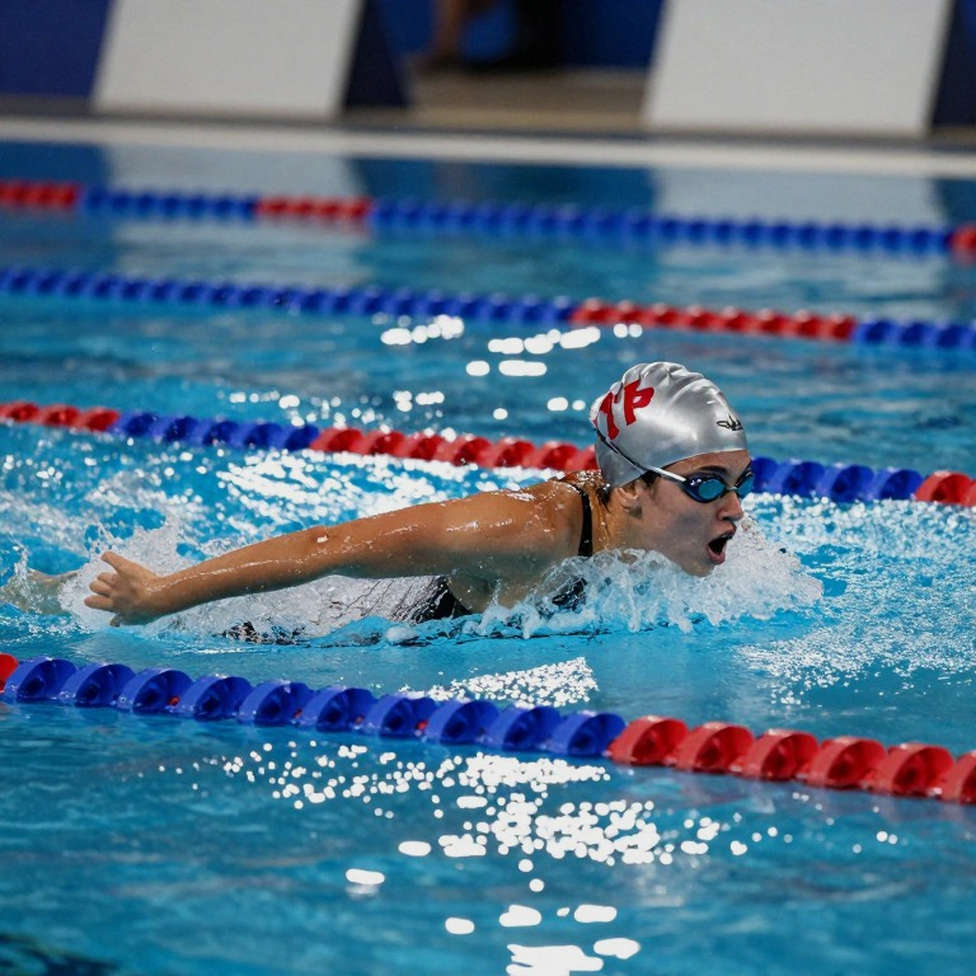
I want to give one specific case to show how double load operates. A 19-year-old female swimmer, freestyle and butterfly, part of the monitored group. In the three months before pools closed, she maintained 32,000 meters a week and two strength sessions weekly. When pools closed, she shifted to four strength sessions a week plus daily band work. After pools reopened, she returned to 30,000 meters a week for two weeks, then rose to 38,000 meters over the next two weeks to prepare for the national meet. She kept four strength sessions a week.
By week six, she began feeling pain in her right shoulder when rotating her arm overhead. She reduced strength intensity but not water volume. By week eight, she could not complete the butterfly session. The later diagnosis was supraspinatus tendinitis and subacromial bursitis. She was sidelined for six weeks.
My analysis identified three errors. First, water volume rose 26% in two weeks, exceeding the 10% weekly threshold. Second, strength intensity did not fall when water volume rose. Third, when symptoms appeared, the intervention reduced intensity rather than volume, while volume was the fastest-rising factor. Had intervention occurred correctly in week three by holding water volume steady and cutting strength to two sessions, the injury would likely not have happened.
This case is not isolated. Of my fourteen cases, nine followed a similar pattern: fast water-volume increase, retained or increased strength work, and late intervention after symptoms appeared. This is a recognizable and preventable pattern.
On the recovery process: Patience as a technique
Once injury occurs, the question shifts from prevention to recovery. This is the area where Vietnamese swimming needs the most change. Performance pressure shortens the recovery process. A swimmer advised to rest four weeks for shoulder tendinitis often returns after two and a half weeks. They return at lower volume, but the post-return rate of increase is often faster than before injury. The result is re-injury.
In my data, the re-injury rate within three months of return was 29%. That figure is high partly because recovery protocols were not fully followed. A scientific recovery protocol for swimming shoulder injury requires four phases: pain reduction and inflammation control, range-of-motion restoration, controlled progressive loading, and return to competition with volume growth no higher than 5% per week. These four phases cannot be shortened without raising risk.
The difficulty is that these four phases produce no immediate competitive result. In a sport where performance is measured in medals and records, a six-week recovery protocol instead of three weeks produces no visible value. So it is often skipped. But the long-term cost is far higher. An athlete who completes six weeks of full recovery returns stronger. An athlete who returns after three weeks and re-injures loses another three months, and may lose a career.
Implications for the athlete's career
A shoulder injury in swimming is not only a medical matter. It is a career matter. An elite swimmer has a competitive window of roughly eight to twelve years. Within that window, every season matters. A six-week shoulder injury can cost a national meet, a national-team slot, or a chance to accumulate international ranking points. For young athletes, losing a season can slow the entire development trajectory.
More broadly, the problem is not individual but systemic. A training system without load data will keep producing preventable injuries. A system without a standard recovery protocol will keep producing re-injuries. And a system that does not measure will never know where it is going wrong. In 19 years of observing the industry, I have seen Vietnamese swimming change greatly in training methods, nutrition, and conditioning. But load and injury management still lags behind the athletes' level.
Vietnam's leading swimmers such as Nguyen Thi Anh Vien and Nguyen Huy Hoang have proven that Vietnamese physical and mental capacity can compete at continental level. But to sustain that performance across multiple Olympic cycles, the system needs a layer of data infrastructure that is currently missing. That layer is load monitoring, injury analytics, and recovery protocols. These do not produce medals directly, but they create the conditions for medals to be sustained.
A progressive thought
If I had one proposal for Vietnamese swimming in the coming cycle, it would be to bring the four load indicators into the weekly training process. No complex system is needed. A spreadsheet with four columns and one rule: when three of four indicators cross the threshold, reduce load. The rule is simple enough to apply at the smallest club level. And if applied, it can cut most shoulder injuries without reducing average training volume.
What I learned after 19 years is not that the body is always weak. What I learned is that the body is always honest. It records every change in load, including those the coaching staff do not record. When we begin to record what the body has already recorded, we begin to speak the same language it does. That language is data. And in that language, injury is not a surprise. Injury is a sentence written weeks earlier, waiting for one final line to complete it.